The Pen Is Mightier Than the Prompt: Writing as a Strategic Skill in the Age of AI

The Conversation That Changed the Frame
A senior engineering leader once walked into my office and asked a simple question.
“How are you able to write so much? Posts. Articles. Even a book. I struggle to get through a two-paragraph email. Writing has never been my thing.”
This was not a junior professional. He had spent two decades building distributed systems used by millions. He could diagnose complex production issues under pressure. He could design clean architectures in real time.
Writing simply never felt central to his role.
For most of his career, that was true.
Today, it is not.
The Structural Shift
For decades, technical professionals built careers around execution. Engineers built. Architects designed. Program managers delivered. Language supported the work, but it was rarely the differentiator.
AI is quietly changing that equation.
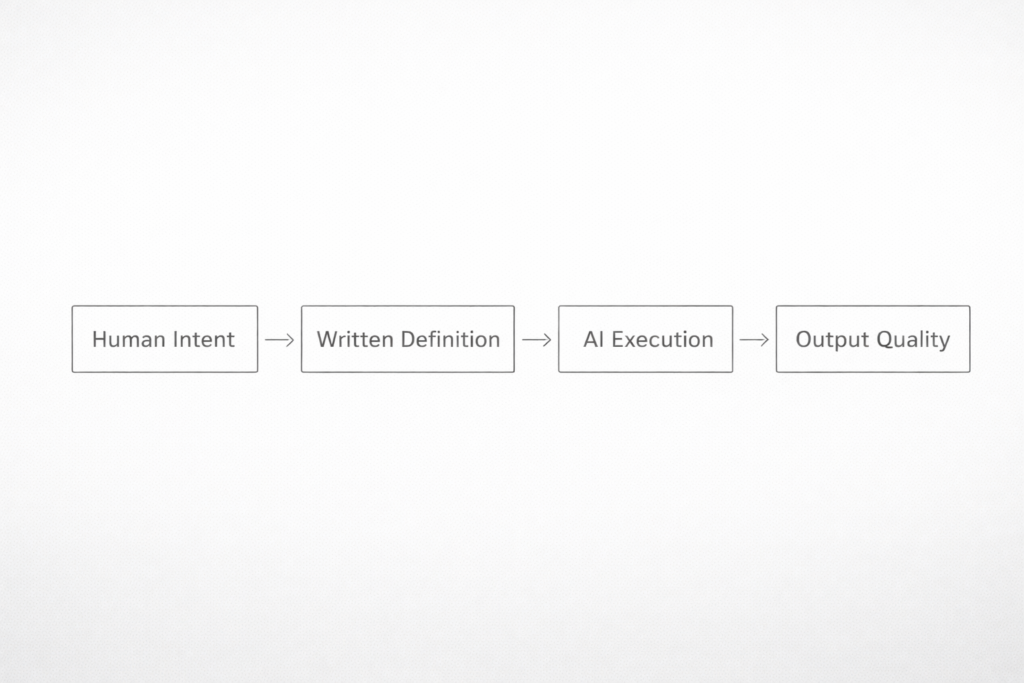
As systems become capable of generating code, summarizing analysis, drafting documents, and simulating reasoning, the constraint is no longer production capacity. It is definition quality.
Every interaction with AI is linguistic. Prompts are written. Constraints are written. Context is written. Refinements are written. The quality of output is directly shaped by the clarity of input.
This is not metaphorical. It is operational.
The professionals extracting disproportionate value from AI are not necessarily those with the deepest tool expertise. They are those who can define intent precisely, specify constraints clearly, and articulate what “good” looks like before the machine begins.
Direction is language. Language is structured thinking.
Why This Feels Counterintuitive
Many technical leaders chose their path because they preferred building over describing. Code was concrete. Systems were logical. Writing felt imprecise by comparison.
But writing, done well, is not about elegance. It is about clarity.
When you write a strong prompt, you are forced to answer questions you might otherwise avoid:
What outcome am I actually seeking?
What constraints matter?
What trade-offs are acceptable?
What audience is this for?
That interrogation is not a literary exercise. It is a cognitive one.
If those answers are unclear, AI will still produce output. It will simply reflect that ambiguity back to you at scale.
A Simple Illustration
Consider the difference between two prompts:
“Summarize this code review.”
Versus:
“You are reviewing a senior engineer’s pull request for a payment processing service. Summarize the key issues, flag potential compliance risks, and organize feedback by severity. Maintain a tone that is direct but respectful.”
Both come from someone who understands the domain. The difference is not technical knowledge. It is definition.
The second instruction provides context, audience, constraints, and structure. The resulting output is materially more useful.
As AI becomes embedded into everyday workflows, implied intent becomes increasingly expensive. Machines execute what is specified, not what is assumed.
Precision compounds.
Writing Is a Thinking Discipline
Several years ago, I wrote more than two hundred pages exploring leadership and technology. I chose not to publish the manuscript. It felt incomplete.
What proved more valuable than publication was the clarity the writing process demanded. Ideas that seemed coherent in my head weakened on paper. Assumptions surfaced. Contradictions became visible.
The document was not the outcome. The clarity was.
Writing forces coherence. It exposes gaps in reasoning. It strengthens internal architecture.
That internal architecture directly influences how effectively you define strategy, evaluate trade-offs, and use AI systems.
AI as an Amplifier, Not an Equalizer
There is a common belief that AI levels capability across professionals. In practice, it tends to amplify differences.
Those who think clearly and articulate precisely are seeing meaningful gains in productivity and quality. Those who rely on implicit understanding often generate larger volumes of output without proportional improvement in decision quality.
The divergence is subtle but real.
As AI systems become more capable, execution accelerates. The bottleneck shifts from production to definition.
The ability to define intent clearly becomes leverage.
A Practical Discipline
This does not require becoming a public writer.
It requires adopting writing as a thinking discipline.
Before prompting AI or delegating significant work, articulate the desired outcome in one clear sentence. Specify constraints deliberately. Define success explicitly.
Draft your thinking before asking a machine to refine it. Use AI to challenge your reasoning, not replace it.
Over time, this habit strengthens:
Prompt quality.
Decision clarity.
Stakeholder alignment.
Strategic coherence.
The compounding effect is significant.
The Strategic Implication
As AI capabilities expand, execution will continue to become faster and cheaper. The limiting factor will increasingly be clarity of definition.
Individuals and organizations that can define intent precisely will extract disproportionate value. Those that rely on shared but unstated assumptions will experience automation without alignment.
Writing strengthens definition.
In that sense, it is no longer a secondary communication skill. It is strategic infrastructure.
The leader who once told me he disliked writing has not become an author. He has simply begun to approach writing as a discipline for clarifying intent. That shift has changed how he uses AI and how he leads.
The question is not whether writing feels natural.
The question is whether effective leadership in an AI-augmented environment is possible without it.
If this resonated with you, I’d love to hear what’s stopped you from writing, or what finally got you started. Drop it in the comments.
Thank You!
