India’s Young Innovators Have AI Ideas. Do They Have a Pathway?
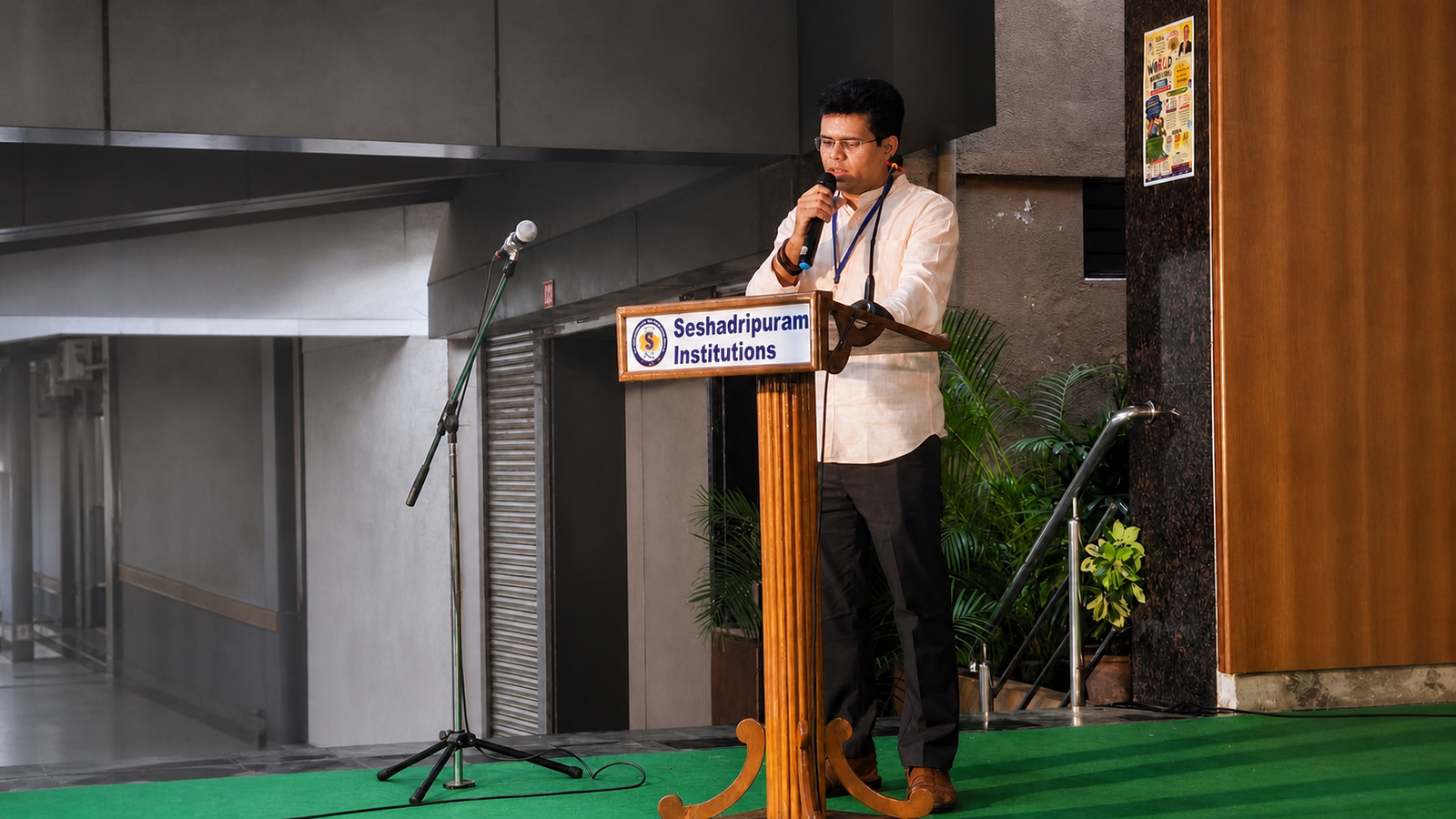
Judging young innovators at World Family Day 2026 left me encouraged by their ideas—and thinking about the institutions they will need next.
At World Family Day 2026, I had the privilege of judging a competition with an ambitious theme: “My AI Plans to Make India a Global Leader.”
The event was organized by SEVAK at Seshadripuram College in Bengaluru. Most participants were senior school students, invited to imagine how artificial intelligence could help India address meaningful challenges.
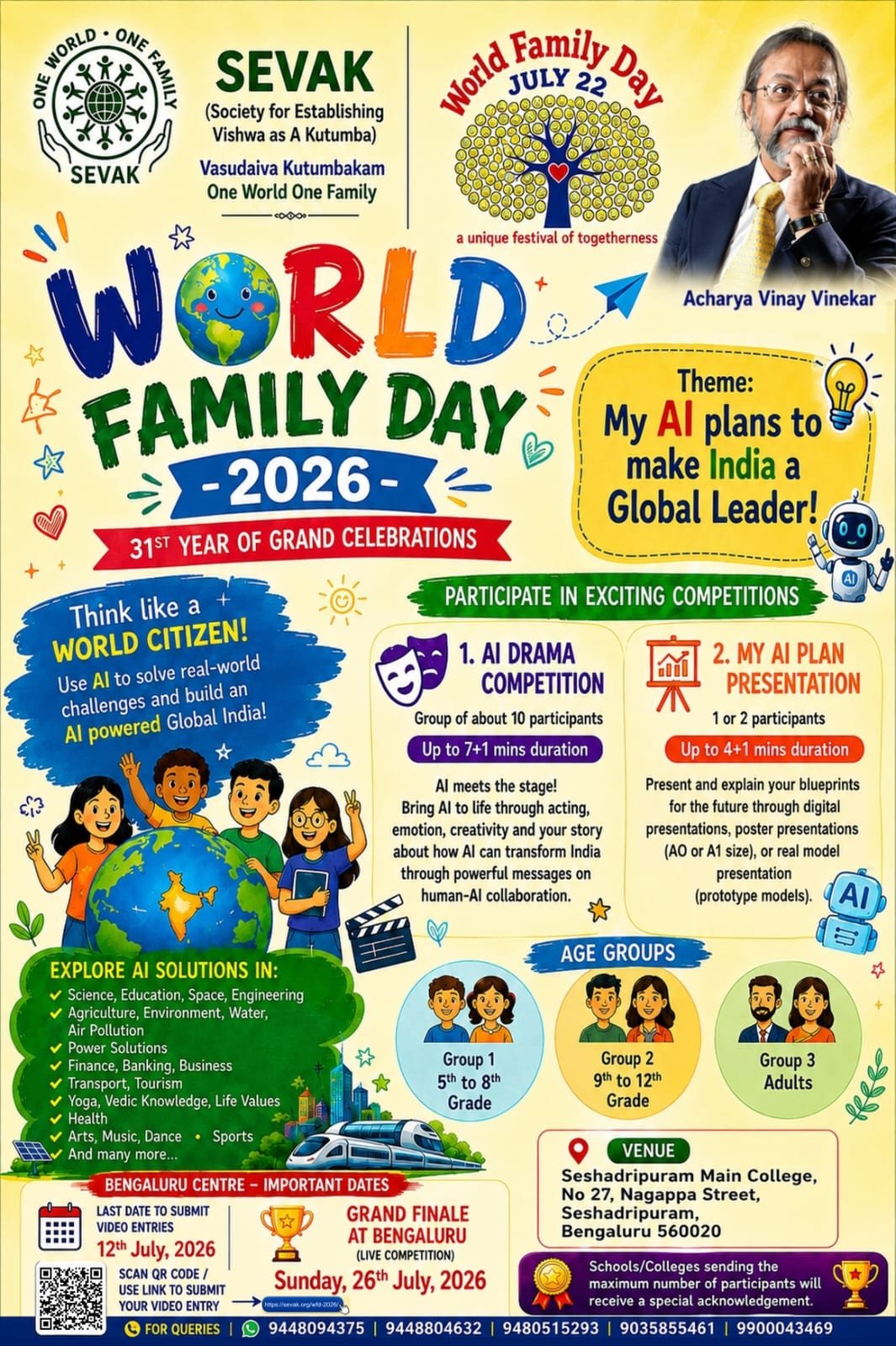
Their presentations covered government administration, education, healthcare, ocean mapping and several other societal needs. The ideas differed, but there was a common instinct behind many of them: these young people saw AI as a means of solving real problems, not simply as a way to build another convenient application.
That was encouraging.
But something else stayed with me after the presentations ended.
The students did not struggle to identify meaningful problems. Many had imaginative ideas and thoughtful answers. What they were less certain about was how to take an idea forward: how to build it, test it, improve it and eventually put it to use.
For students at this stage, that is entirely understandable.
The gap was not in their imagination. It was in the pathway available after imagination.
We should not expect school students to be implementation experts
It would be unreasonable to assess senior school students using the standards applied to a startup, an enterprise technology programme or a government deployment.
They should not already be expected to understand procurement, data architecture, regulatory compliance, product-market fit or institutional change.
At this stage, their most important achievements are different:
- recognizing a problem worth solving;
- imagining how technology might help;
- asking questions;
- communicating an idea;
- and developing the confidence to build something new.
A competition can awaken that confidence. It can help a young person see that technology is not something created only by distant companies or experts. It is something they can learn to shape.
But once that interest has been awakened, what happens next?
That is where institutions begin to matter.
A platform is valuable. A pathway is more valuable.
India now has many school competitions, hackathons, innovation challenges and student showcases. They create visibility, recognition and excitement.
Those outcomes matter. Not every competition needs to produce a company or a production-ready system.
But for a student who wants to continue, the next step is often unclear.
Whom should they approach?
What should they learn first?
How can they determine whether the problem they identified is real and understood correctly?
Where can they find a mentor who understands both AI and the domain?
How can they access tools or data safely?
What does an age-appropriate first prototype look like?
The student may leave the event with a certificate, photographs and renewed enthusiasm, yet still lack a practical answer to the most important question:
“What do I do with this idea now?”
This is the guidance gap.
India has begun building parts of the ecosystem
India’s national AI strategy has long emphasized socially useful applications.
NITI Aayog’s National Strategy for Artificial Intelligence proposed an “AI for All” approach focused on inclusive growth and sectors such as healthcare, agriculture, education, infrastructure and mobility. It also argued that solutions developed for India’s scale and complexity could become relevant to other emerging economies. The strategy recognized that research, skills, collaboration and pathways from prototypes to usable products would all be necessary.
The IndiaAI Mission is building a wider ecosystem around compute, datasets, foundation models, future skills, application development, startup financing, and safe and trusted AI.
Its AIKosh University Engagement Programme, for example, is designed to give university students access to datasets, models, workshops and innovation challenges. The IndiaAI FutureSkills initiative supports undergraduate, postgraduate and doctoral students pursuing work in AI and related fields.
The YUVA AI for All programme is intended to expand foundational AI understanding among younger learners and encourage responsible use.
These initiatives are important. But from the perspective of a school student with an early idea, they may still appear as separate opportunities rather than one understandable journey.
The missing element is often continuity.
What a guided pathway could look like
A student does not need to move directly from an idea to full implementation.
The next journey can be smaller, safer and more educational.
1. Start with a mentor
The first need is not funding. It is guidance.
A mentor can help the student examine the problem, understand what they do not yet know and identify the next skill to learn. The mentor need not build the solution for them. Good mentorship turns enthusiasm into disciplined curiosity.
Ideally, students should have access to two perspectives: someone who understands technology and someone familiar with the problem domain.
A healthcare idea should eventually encounter a doctor, public-health worker or hospital administrator. An education idea should be discussed with teachers and students. A proposal for government administration needs exposure to people who understand how public systems actually operate.
2. Explore the problem before building the solution
Young innovators often encounter the same temptation as experienced technology teams: moving too quickly from an interesting problem to a preferred solution.
Before building, students could be taught to ask:
- Who experiences this problem?
- How is it handled today?
- Why does the problem continue to exist?
- What information would help us understand it?
- Is AI necessary, or would a simpler intervention work better?
Learning to investigate a problem may be more valuable than immediately producing a polished demonstration.
3. Build a small prototype
The first prototype should not attempt to transform an entire hospital, school or government department.
It might test one assumption, use a small synthetic dataset, model a simplified workflow or demonstrate one part of the proposed experience.
The objective at this stage is learning.
Did the idea work as expected? What did users find confusing? Which assumption turned out to be wrong? What new skill does the student need?
A prototype becomes valuable when it produces better questions, not merely when it looks impressive.
4. Experiment within safe boundaries
Young people need access to AI tools, but access should be accompanied by guidance about privacy, bias, accuracy, intellectual property and appropriate use.
A student working on healthcare should not need real patient records to learn. A student exploring education should understand why personal data requires protection. A system making recommendations should be presented as an experiment, not as an authority.
Responsible AI education becomes more meaningful when it is attached to something the student is actually trying to build.
5. Create a bridge to the next institution
Schools cannot provide every resource indefinitely. They can, however, help students find the next appropriate environment.
That might be:
- a college laboratory;
- an Atal Tinkering Lab or similar maker space;
- a structured mentorship programme;
- an industry-supported student initiative;
- a nonprofit working in the relevant domain;
- a university innovation challenge;
- or, at a later stage, an incubator or government programme.
The transition should be gradual. A student may move from curiosity to foundational learning, then to a prototype, further education and eventually a serious application.
No single institution needs to own the entire journey. But someone should help the student find the next step.
Competitions can become the beginning of a relationship
A competition understandably concentrates effort on the event itself: entries, judging, presentations, awards and recognition.
What if a small part of that effort were reserved for what follows?
Organizers could identify a few students who show sustained curiosity, not only those with the most polished presentations. Each could receive a limited period of mentorship after the event.
Schools and colleges could maintain a shared directory of laboratories, mentors and programmes. Enterprises could contribute practitioners willing to spend a few hours each month guiding young innovators. Domain institutions could offer carefully framed problem statements that students can explore without accessing sensitive systems or data.
Previous participants could return the following year to describe what they tried, what failed and what they learned.
Success would no longer mean that every winning idea became a startup.
It might mean that a student learned enough to change the idea completely. Another might discover a field of study. Someone else might build a modest but functional prototype. A student may even conclude that AI was not the right solution.
All of these can be valuable outcomes.
We should not turn curiosity into another performance target
There is an important caution.
Once we begin discussing pathways, prototypes and national leadership, it becomes easy to place adult ambitions on young people.
Not every student needs to become an entrepreneur. Not every idea needs to be commercialized. Not every competition needs an accelerator attached to it.
Curiosity has value before it produces economic output.
Students need room to experiment, change direction, lose interest and begin again. Excessive structure can turn exploration into another performance metric.
The purpose of a support system should therefore not be to push every student towards implementation. It should ensure that a motivated young innovator who wants to continue is not left without guidance.
The pathway must be available, not compulsory.
What India’s AI leadership could mean
Global AI leadership is often discussed through models, compute capacity, research publications, investment and startups. Those capabilities matter, and India will need to strengthen them.
The 2026 Stanford AI Index shows that frontier-model production remains concentrated largely in the United States and China, even as open-source participation becomes more geographically distributed.
India cannot define leadership only through enthusiasm for applications.
But leadership should not be defined only by who builds the largest model either.
India also has an opportunity to cultivate generations of people who can identify consequential problems, work across disciplines and apply AI responsibly in difficult real-world environments.
That process can begin long before university.
A senior school student who thinks about improving education may not build a national platform today. With the right guidance, however, that early curiosity could influence what the student studies, builds and contributes over the next decade.
The effect of these competitions may therefore be much larger than the ideas presented on the day.
But only if interest is given somewhere to go.
The responsibility belongs to the ecosystem
I left the World Family Day competition with confidence in the imagination of the students.
They were willing to think about healthcare, education, administration, science and society. They were not waiting for someone else to tell them that these problems mattered.
We should be careful, however, not to celebrate their ideas and then place the burden of continuation entirely on them.
Schools can nurture curiosity. Colleges can open laboratories and learning opportunities. Enterprises can contribute mentors and engineering experience. Government programmes can make age-appropriate resources easier to discover. Nonprofits can connect young people with social problems and the communities experiencing them.
Families and teachers can encourage students without demanding immediate success.
The young innovators have already taken the first step: they have imagined what AI might make possible.
Our responsibility is to ensure that when one of them asks, “How do I take this further?”, there is someone—and somewhere—ready to answer.
India is asking its young people to imagine how AI can transform the country.
When they respond with ideas, have we built the institutions that help them take the next step?
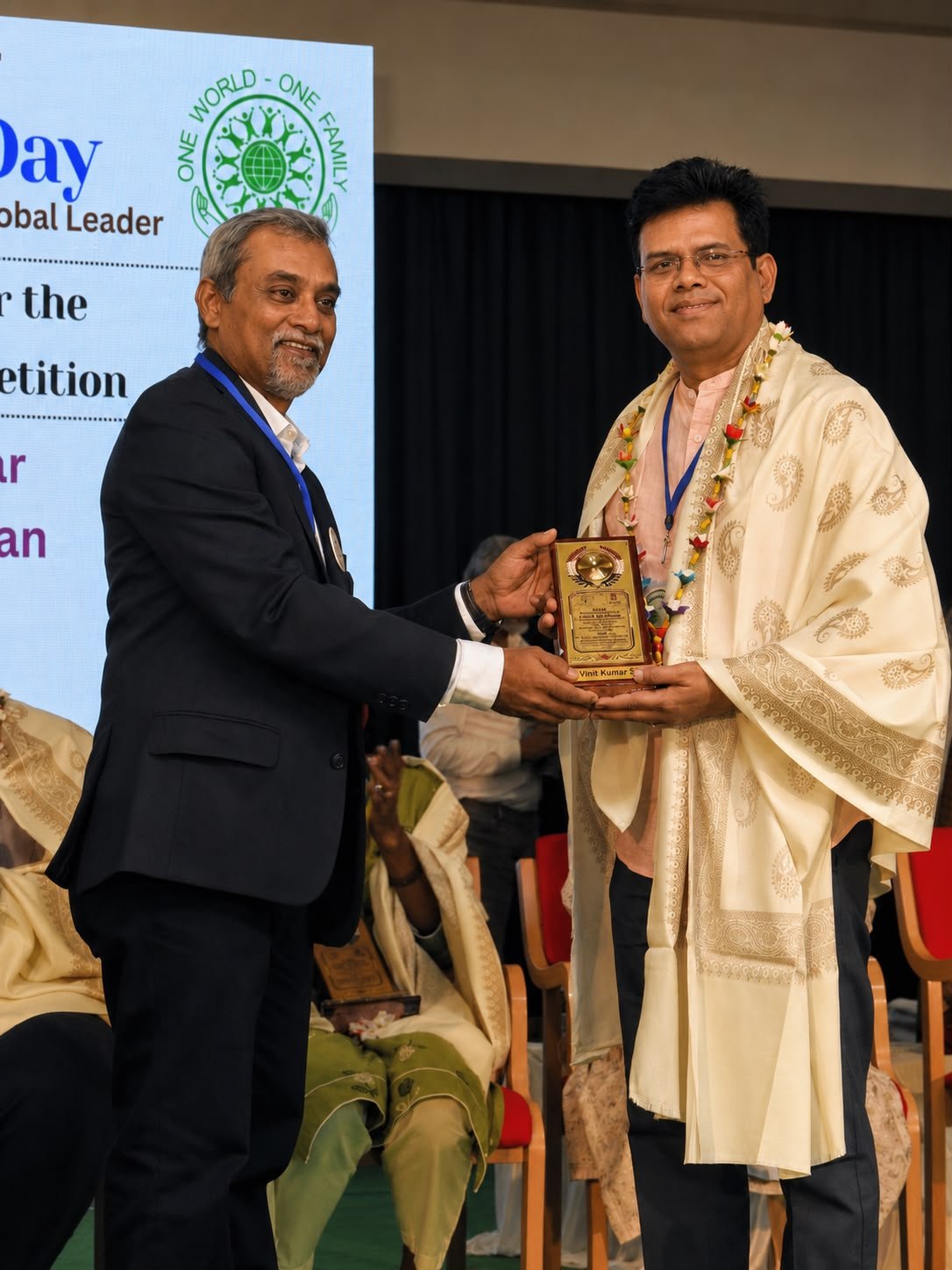
I was honoured to serve on the judging panel alongside Sandhya Ramachandran Arun and Hemanth Mahesh. My thanks to Acharya Vinay Vinekar and SEVAK for creating this platform, to Seshadripuram College for hosting the event, and to Arun PV, PCC, for recommending me for this opportunity.
Continue the conversation
Receive thoughtful, research-backed essays on strategy, leadership, AI and execution. New writing when there is something worth sharing.
Confirm your subscription by email. Unsubscribe at any time.
