When AI Becomes More Intelligent, What Should Humans Become?

What a family trip to watch Hanuman Ansh made me reconsider about intelligence, service and leadership in the age of AI
Last Friday, my daughter and I had one of those rare family coincidences: a holiday on the same day.
Adobe had given us a Global Wellbeing Day. Her school was closed around the Onam festivities. We decided to watch a movie together.
The choice was between Spider-Man and Hanuman Ansh.
I thought I knew which one she would pick.
I was wrong.
She chose Hanuman Ansh.
I am glad she did.
What began as a family afternoon at the cinema sent me down a rabbit hole I had not anticipated. I knew something about Neeb Karori Baba, affectionately called Maharajji by his followers, but not enough to understand the unusual reach of his influence.
That search took me from an Indian spiritual teacher who died more than fifty years ago to a Harvard psychologist, Steve Jobs, Mark Zuckerberg, a physician fighting smallpox and, unexpectedly, back to something I spend considerable time thinking about today: artificial intelligence.
Neeb Karori Baba had nothing to say about AI. Turning him into an AI philosopher or management guru would be absurd.
But the film left me with a question I have not been able to shake:
As machines become more intelligent, what should humans become?
What were they searching for?
The connection between Neeb Karori Baba and the technology world is intriguing, although popular retellings often make it tidier than the evidence permits.
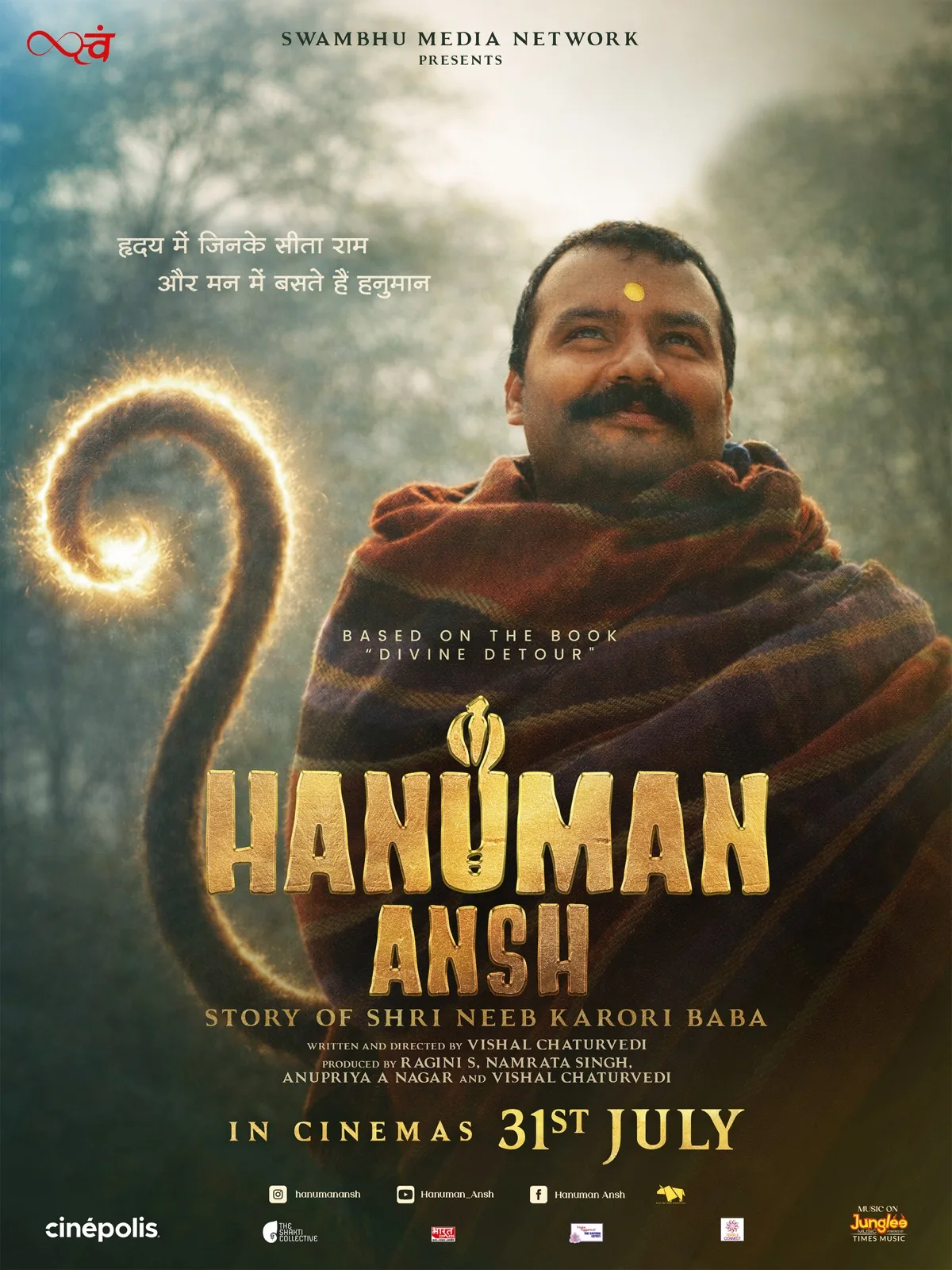
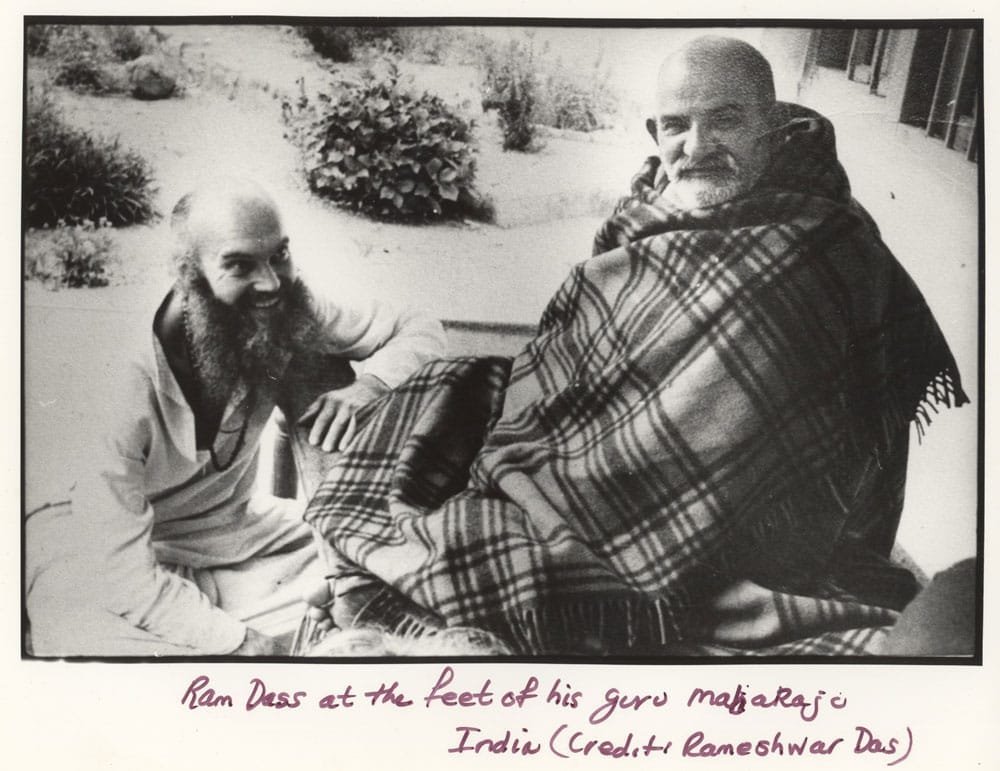
Richard Alpert was a Harvard psychologist before travelling to India in 1967, meeting Neeb Karori Baba and becoming Ram Dass. His 1971 book Be Here Now introduced generations of Western readers to ideas about awareness, consciousness and service. The official Ram Dass archive documents that journey.
Steve Jobs travelled to India in 1974 during his own search for meaning and direction. Neeb Karori Baba had died the previous year, so Jobs never met him. I could not find strong primary evidence for the popular claim that Be Here Now directly sent Jobs to find Baba. The safer conclusion is that Jobs was part of a wider generation of Western seekers drawn towards India.
Decades later, Mark Zuckerberg publicly recounted asking Jobs for advice when Facebook was struggling. Jobs encouraged him to visit a temple in India that had mattered during his own early search. Zuckerberg said the trip helped him reconnect with Facebook’s mission. His account appears in the 2015 town-hall transcript.
These associations do not validate a spiritual teacher. Nor does an ashram visit make a company’s later decisions wise.
They do, however, reveal a recurring pattern: people operating near the frontiers of psychology, technology and entrepreneurship sometimes went looking for something that knowledge and achievement alone did not provide.
What were they searching for?
Perhaps the language varied: meaning, intuition, clarity, purpose, connection. But the search itself suggests a limit that has become even more relevant in the age of AI.
Capability can help us do more. It cannot, by itself, determine what is worth doing.
AI is separating capability from humanity
For most of human history, many cognitive capabilities were scarce. Knowing more mattered. Remembering mattered. Writing, analysis and calculation mattered. Organizations rewarded people for having answers that others did not.
AI is changing that equation.
Stanford’s 2026 AI Index reports that organizational AI adoption reached 88 percent, while leading systems continued to improve across scientific reasoning, mathematics, coding and computer-use benchmarks. It also describes a jagged frontier: systems can excel on difficult tests and still fail on seemingly elementary tasks. Stanford AI Index 2026
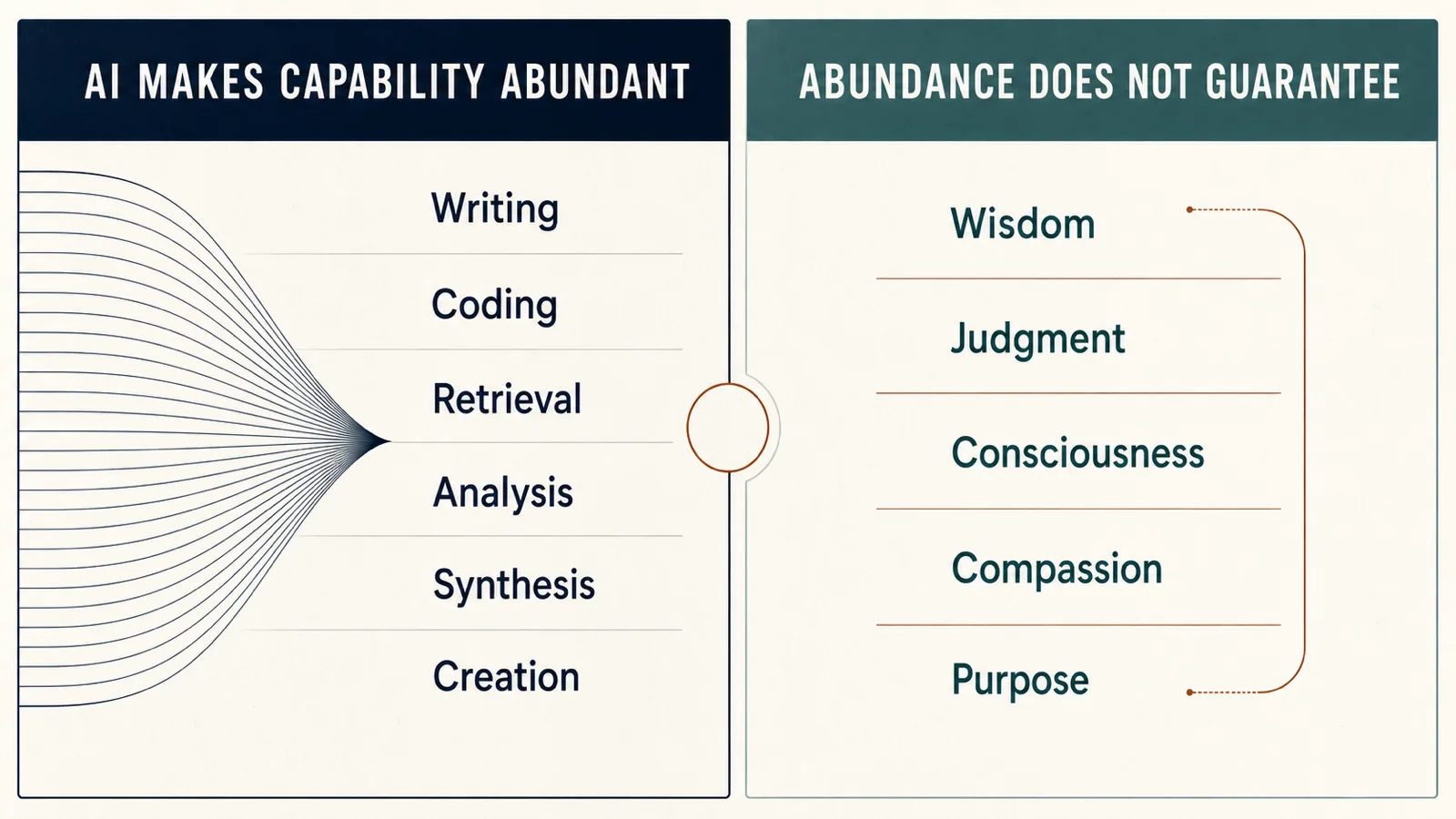
AI can already write, code, retrieve, translate, summarize, analyse and create. Agents increasingly perform multi-step work rather than answering isolated questions. Cognitive production is becoming cheaper and more abundant.
But capability is not wisdom. It is not judgment, compassion or purpose. A system can become extraordinarily capable without determining what that capability should serve.
This gives us a causal chain that leaders should take seriously:
AI makes cognitive production abundant. Abundance reduces the differentiating value of production alone. Judgment, purpose and attention become more consequential. Organizations must develop those capabilities deliberately.
Perhaps AI will force us to discover that intelligence was never synonymous with humanity.
Stillness before influence
One feature of Neeb Karori Baba’s portrayal in the film stayed with me. His influence did not appear to come from trying to influence. There was little need to demonstrate importance.
The contemporary leadership environment often rewards the opposite: immediate reaction, constant communication and visible certainty. AI can intensify that tendency by making it effortless to generate another analysis, presentation, recommendation or message.
But more output does not necessarily create more clarity. It may only increase the volume through which people must search for it.
Stillness, in this context, does not mean passivity. It means creating enough distance from the stream of activity to distinguish signal from noise, urgency from importance and a plausible answer from the right decision.
When AI makes activity abundant, clarity becomes a leadership advantage.
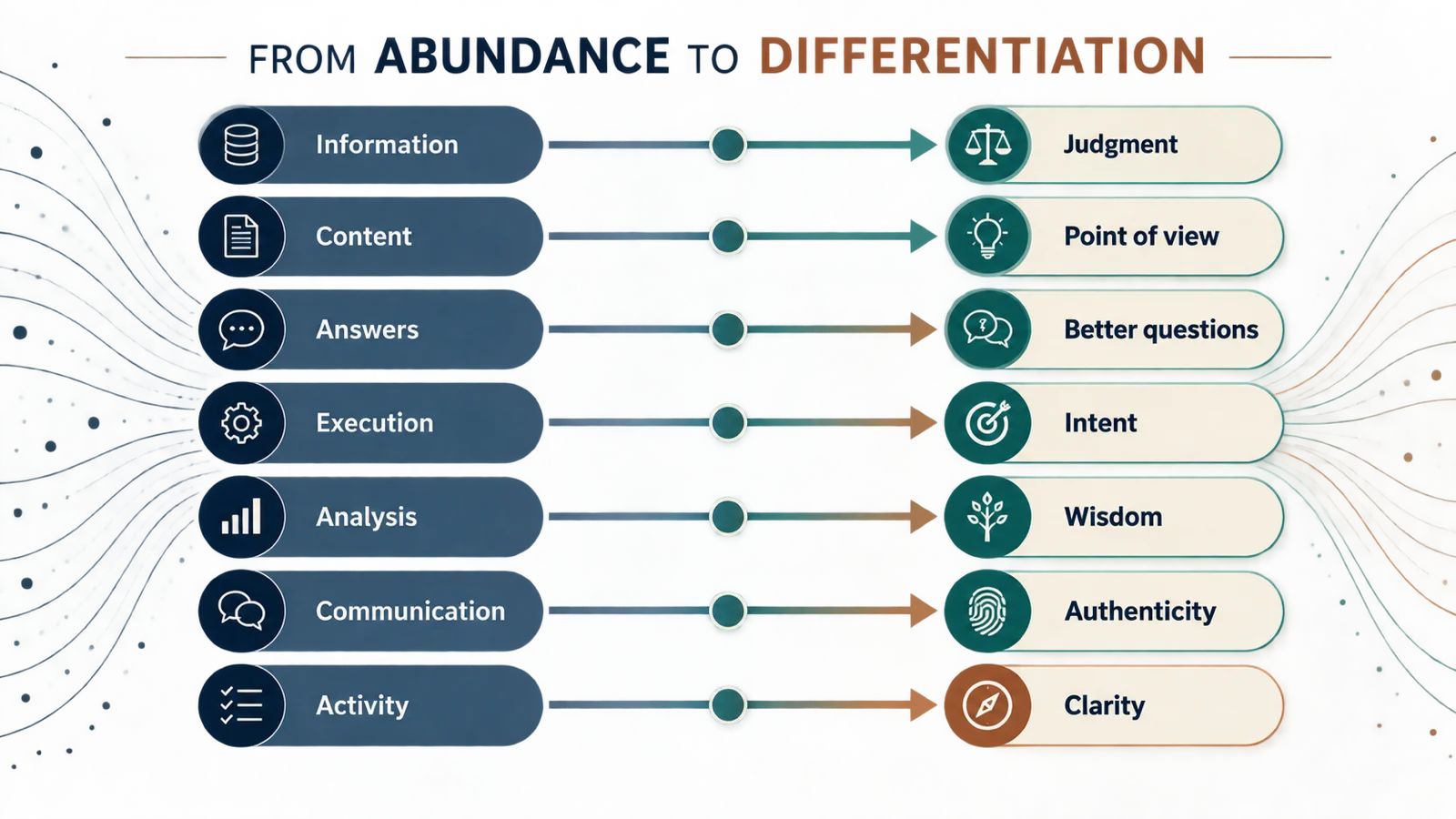
This changes what expertise must deliver. Information must become judgment. Content must become a point of view. Answers must lead to better questions. Execution must serve intent. Analysis must contribute to wisdom. Communication must retain authenticity. Activity must produce clarity.
Two very different meanings of consciousness
Could an artificial system ever have subjective experience?
No one currently knows. Researchers have proposed indicators derived from several scientific theories of consciousness, but those theories remain contested. A substantial interdisciplinary review concluded that current AI systems did not satisfy its proposed indicators, while also finding no obvious technical barrier to future systems doing so. Butlin and colleagues, 2023
That scientific question must not be confused with a different, everyday use of the word conscious: living with deliberate attention.
The two are not equivalent. Yet placing them beside each other exposes an irony.
We are asking whether machines might someday have subjective experience while building systems that can increasingly direct human attention. Notifications interrupt thought. Algorithms select what appears before us. AI will make persuasion and personalization more precise.
Whatever the future of machine consciousness, leaders already face a present responsibility: to preserve human agency over attention.
For a spiritual seeker, Neeb Karori Baba’s emphasis on remembrance has a religious meaning. A secular reader need not share that belief to recognize the practical challenge: remember what matters, notice where attention is going, and do not confuse measurement with meaning.
The harder test is service
Most enterprise AI initiatives begin with productivity. How much time can we save? What can we automate? How much cost can we remove?
These are necessary questions. They are not sufficient.
Suppose AI reduces a five-hour task to thirty minutes. If the recovered time is simply filled with more tasks, we may create a more productive organization without creating a better one.
What if managers spent less time generating status reports and more time coaching? What if engineers spent less time producing routine code and more time solving consequential problems?
AI creates capacity. Leadership decides what that capacity serves.
Larry Brilliant provides a more substantive bridge from Neeb Karori Baba to modern institutional life than any celebrity association. Brilliant has recounted that, while living in a Himalayan ashram, Neeb Karori Baba repeatedly directed him towards the World Health Organization’s smallpox-eradication programme. Brilliant eventually joined the effort in India. In a 2023 Harvard lecture, he described that journey himself.
The point is not that spirituality eradicated smallpox. It did not. A vast effort by public-health workers, governments and communities did that work.
The deeper pattern is more demanding: private conviction became disciplined service inside a difficult institution, in pursuit of a measurable human outcome.
That offers a stronger test for AI leadership than productivity alone:
Who becomes meaningfully better off because of the capability we are creating?
For every capability transferred, strengthen one
AI will also disrupt professional authority. A less experienced person with capable tools can access and synthesize knowledge that once took years to accumulate. Experience remains valuable, but its value moves upward.
Leadership becomes less about “I know more” and more about:
- I can judge better.
- I know which question matters.
- I can take responsibility when there is no obvious answer.
- I know what should not be optimized.
This suggests a practical principle for enterprise transformation:
For every capability transferred to AI, decide which human capability should become stronger.
If AI handles first drafts, strengthen critical thinking. If it retrieves information, strengthen the ability to ask better questions. If it performs routine analysis, strengthen judgment. If it makes execution faster, strengthen the ability to decide what is worth executing.
Otherwise, organizations may become enormously augmented while allowing the human capabilities that make augmentation valuable to weaken.
Four questions for every important AI decision
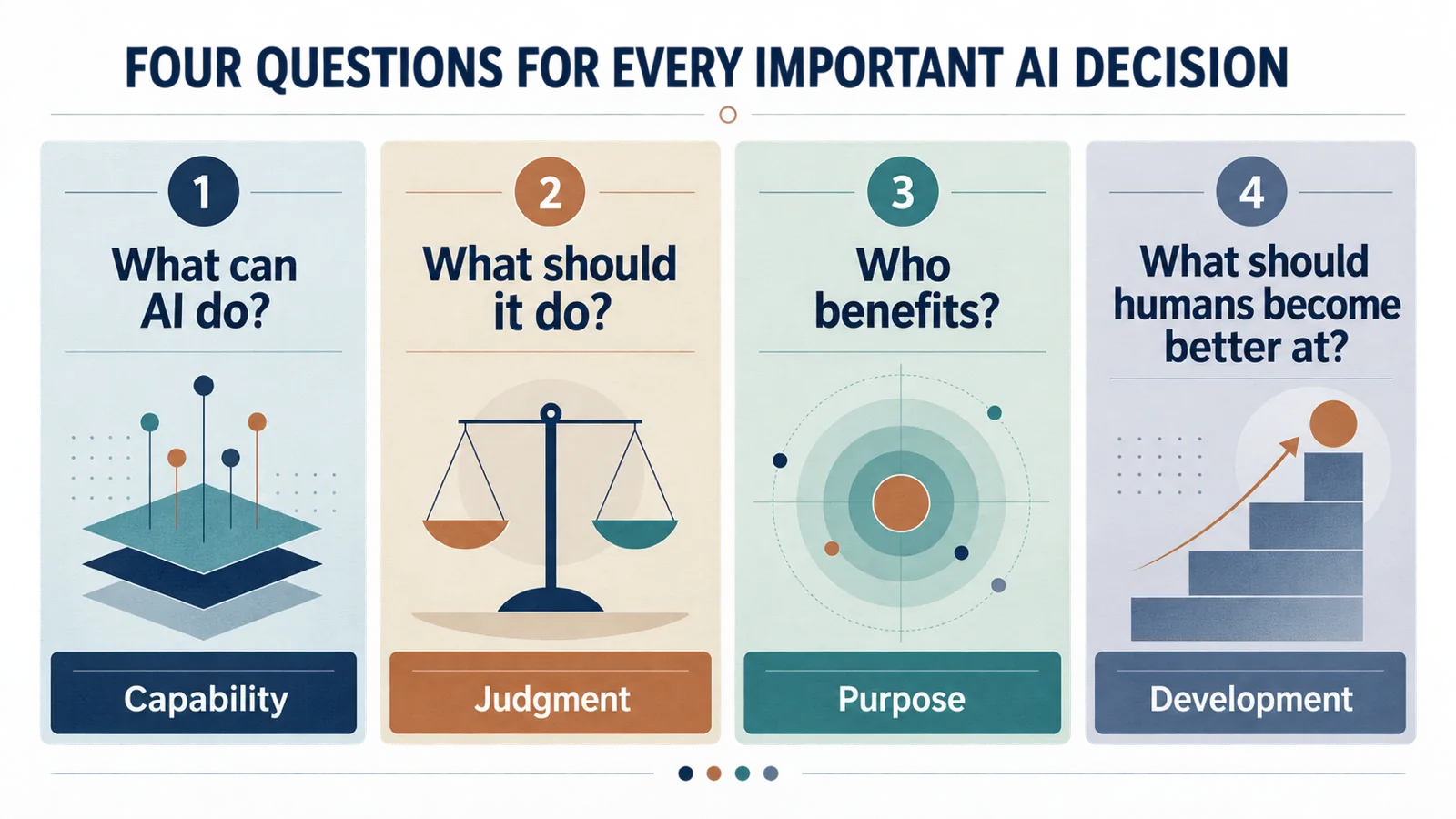
1. Capability: What can AI do?
Understand the frontier. Do not let institutional habit disguise what has become possible.
2. Judgment: What should it do?
Technical possibility does not automatically justify organizational practice. Accountability remains human.
3. Purpose: Who benefits?
The customer, employee, shareholder and society may not benefit equally. Leadership begins where their interests diverge.
4. Development: What should humans become better at?
If AI removes something from human work, decide deliberately what should grow in its place.
The first question dominates most AI conversations. Organizations that navigate this transition well will become equally serious about the other three.
Back to that choice
Looking back, I am glad my daughter surprised me.
You do not have to share Neeb Karori Baba’s beliefs, accept stories of miracles or treat a film as history to engage with the questions his life raises.
We are racing to build machines capable of extraordinary intelligence. But intelligence may never have been the whole measure of human development.
Can we exercise better judgment? Can we use greater capability in service of others?
Perhaps the most important question of the AI age will not be whether machines eventually become more like us.
It may be what we choose to become as machines become capable of doing more of what once made us feel uniquely intelligent.
My daughter chose Hanuman Ansh over Spider-Man that afternoon.
I am glad she did.
Thank You!
Continue the conversation
Receive thoughtful, research-backed essays on strategy, leadership, AI and execution. New writing when there is something worth sharing.
Confirm your subscription by email. Unsubscribe at any time.
